Managing Costs Across the UK Construction Lifecycle: Risk, Contingency and Stage-Based Cost Control
The RIBA Plan of Work is the UK construction sector’s most widely recognised framework, providing a common set of stages used by architects,
Bauwise software solution
Bauwise equips real estate developers with an automated construction cost management system to govern variations and contingency, preserve forecast integrity against the development appraisal, and maintain portfolio-level visibility of margin and capital risk throughout construction delivery.
Bauwise supports Real Estate Developers with an automated construction cost management tool that:
Bauwise helps Real Estate Developers and their teams govern variations, preserve forecast integrity, and manage portfolio-level cost risk.
Construction project profitability
Construction Projects
Of Construction Budgets


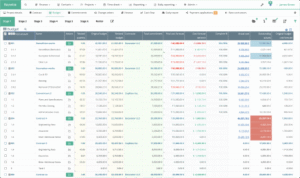
Allocate budget based on construction stages or buildings. Track Forecast to Complete (FTC) and Estimate at Completion (EAC). Control budgets through versions and approval locks. Forecast profitability, manage accruals, and sync financial data with integrated accounting or ERP software.
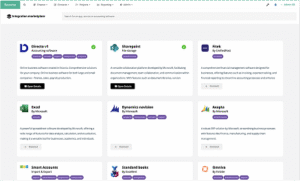
Automate data flow between your ERP or accounting software and Bauwise. When integrated, construction-related invoices flow directly into Bauwise for approval and return to the ERP or accounting software enriched with data — cost allocations, budget lines, and approver info — no double work required.
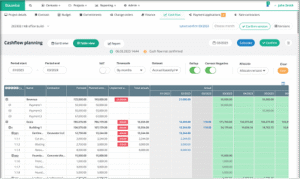
Get a structured, automated framework to plan, forecast, and monitor construction cash flow across all project stages. Generate cash flow forecasting baselines with one click, fill past periods with actual cost and revenue data, and align projections with the project’s Cost-at-Completion (CAC). Refine future forecasts, adjust monthly distributions, and manage approvals through version-controlled tracking.
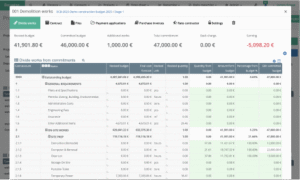
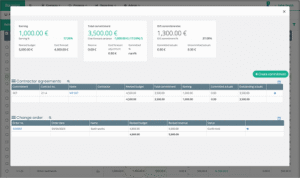
Automate commitments — create purchase orders (PO) and subcontractor contracts directly from budget lines. Manage scope changes, variations, and back charges from Applications for Payment (AfP) in real time. Track actuals, advances, and accruals at every stage. Allocate contingency reserves, forecast accurately, and centralize all vendor data for better procurement decisions.
Track, review, and approve construction project scope changes. Submit change order requests with attachments, automatically calculate their impact on project cost, and adjust budgets upon approval. Maintain versioned audit trails and status tracking to ensure compliance, transparency, and project continuity.
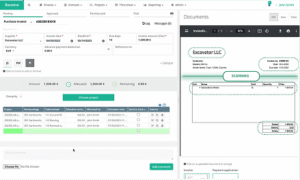
Automate purchase invoice processing with AI-powered data extraction, pre-defined approval workflows and unique invoice allocations. Link invoices directly to purchase orders (PO), contracts or Applications for Payments (AfPs). Manage consolidated invoices for multiple projects between different teams. Meet governance standards, and comply with internal financial policies.
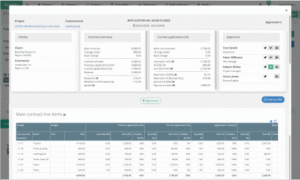
Accelerate month-end reporting between Contractors and Subcontractors by streamlining the Applications for Payment process into a structured, auditable workflows. Initiate change orders and track progress, apply retentions and back charges with full compliance. A dedicated Subcontractor portal, automated notifications, and digital validation keep all parties aligned.
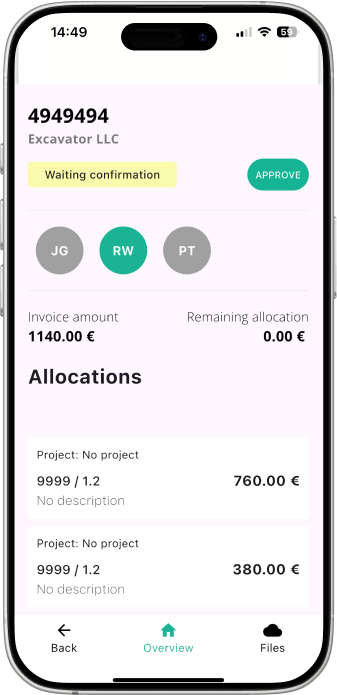
Review and approve construction invoices directly from your mobile device. Capture receipts and invoices — the Bauwise Mobile App uses AI-powered image recognition to extract data from images. Allocate receipts and invoices using Bauwise Purchase Invoice Management module.
Bauwise equips construction CEOs with an automated cost management tool to maintain financial control, efficiency, and profitability across expanding portfolios. The cost management software links budgets, forecasts, contracts, and purchase orders in one system, enforcing approval workflows that preserve budget integrity and accuracy. Chief Executive Officers gain real-time visibility into consolidated portfolio performance, safeguarding project continuity, automating reporting, and simplifying construction portfolio management.
Bauwise provides an automated cost management solution for construction CFOs to obtain timely, verified financial data for cash flow and refinancing decisions. The software consolidates construction budgets, contracts, purchase orders, change orders, invoices, and Applications for Payment into a unified data source, ensuring all figures are validated, traceable, and audit-ready before reaching financial statements. Chief Financial Officers can track contingency budgets and risk reserves, gain visibility into liquidity, flag budget overruns early, and forecast portfolio-level cash flow.
Bauwise helps Construction Managers and Division Managers ensure all construction project costs are reported and accounted for, using an automated construction cost management tool. The software tracks linked budgets, contracts, purchase orders, and change orders, so every commitment is recorded, allocated, and tied to the correct project and cost code. Construction and Division Managers can leverage automated purchase invoice and Application for Payment validation rules with audit trails, compare planned versus actual costs in real time, and monitor division-level performance across projects.
Bauwise supports Construction Quantity Surveyors with an automated cost management solution to plan and manage full cycle construction costs — from forecasting and tendering to variation valuations and reporting. The software reconciles interim valuations, change orders, and actual costs in real time, updating forecasts and Estimate at Completion (EAC) automatically once costs are approved. It generates RFQs and tender packages, standardizes bids formats, and applies approval workflows. Links approved variations to their related contracts and cost codes, calculating their budget, commitments and EAC impact.
Receive invoices requiring your final approval directly from your construction team
Review invoices together with all linked documents
Track invoice statuses and see the pipeline of previous approvers
Capture physical receipts and invoices directly with your mobile device
Captured invoices will be sent into Bauwise platform and assigned to your name for further allocation
Review the AI-extracted invoice and receipt data using the Purchase Invoice Management module
Allocate invoices and receipts using Purchase Invoice Management module
Route invoices based on roles or manually to the next assignee, once allocation is completed
try now
The typical learning time is just two sessions, while our software can save you up to 4 workdays per month
We’ve got your questions covered. If you can’t find the answer you’re looking for below, feel free to contact us.
Bauwise is designed for residential, commercial, mixed-use, industrial, and build-to-rent developers managing construction cost risk across one or more active developments.
It is used by platform and portfolio developers allocating capital across multiple projects or funds, as well as developer-operators who rely on external quantity surveyors, project managers, and contractors while retaining financial accountability for budget adherence and margin outcomes.
Bauwise supports organisations whose primary delivery-phase risk is margin erosion caused by unmanaged variations, contingency misuse, and distorted forecast outturn relative to the approved development budget and financial assumptions.
Traditional quantity surveyor (QS) cost reports are periodic, retrospective snapshots that consolidate information after costs have already been committed, instructed, or incurred. By the time variances appear in a monthly report or spreadsheet, the underlying commercial decisions are often irreversible.
Bauwise operates as a continuous cost management system. It records variations, contingency movements, commitments, and approvals at the point they arise, enforces whether they are allowed to affect contract value or forecast outturn, and shows their margin impact immediately against the approved development budget.
Bauwise does not replace Quantity Surveyors (QSs) or Project Managers (PMs), nor does it alter their contractual roles or professional responsibilities. QSs and PMs continue to administer contracts, assess variations, prepare valuations, certify payments, and manage day-to-day delivery.
Bauwise provides a central cost governance layer used alongside those roles. It ensures that variations, contingency reallocations, commitments, and forecast updates submitted by advisors are recorded using a consistent structure, formally approved, and reflected in contract value and forecast outturn only in accordance with contractual status and approvals.
This allows developers to govern financial outcomes without interfering in technical assessments or contract administration, while maintaining a single, auditable source of data across all advisors, projects, and delivery stages.
Bauwise separates potential, instructed, and agreed variations and prevents unagreed items from automatically distorting forecast outturn. Each variation is recorded with an explicit approval status, so only formally instructed or agreed items are permitted to affect forecasts or contract value.
Contingency can only be drawn through explicit allocation to defined work packages and cost lines, ensuring contingency usage is deliberate, traceable, and visible, rather than being silently absorbed into forecasts as costs increase.
Bauwise supports cost governance across multiple projects, stages, and funds using a single, developer-defined reporting structure. This allows committed cost, forecast outturn, contingency, and commercial exposure to be aggregated consistently at portfolio level.

At the same time, real estate developers retain full drill-down to individual projects, stages, packages, contracts, and cost line items, enabling portfolio-level oversight without losing project-level accountability or cost detail.

The RIBA Plan of Work is the UK construction sector’s most widely recognised framework, providing a common set of stages used by architects,

In construction finance, profitability depends on data accuracy and timing — yet achieving both consistently and at scale remains an industry-wide challenge. The


Construction markets worldwide continue to face rising costs and price volatility. Material prices, freight and energy costs, labour availability, and tariff conditions can shift faster
Dont see Calendly for booking? Click Here to open Calendly
We use cookies on our website to give you the most relevant experience by remembering your preferences and repeat visits. By clicking “Accept All”, you consent to the use of ALL the cookies.