In construction, financial reporting and project cost control operate on different timelines: one consolidates financial transactions after they occur, while the other manages commitments, variations, and forecast exposure before they impact financial results.
As digital adoption accelerates, over 72% of mid-to-large construction firms now use dedicated software for project tracking or financial management — and the average construction business uses over six different platforms, often with limited integration. This fragmentation reinforces the disconnect between what is reflected in financial reports and what is happening at the project level.
In this context, construction accounting software and construction cost management software — widely seen as interchangeable — serve fundamentally different control functions.
Accounting operates at the statutory and consolidation layer, ensuring general ledger (GL) accuracy and reporting compliance. Cost management operates at the project execution layer — where procurement decisions, subcontract awards, variation approvals, payment certification, and Forecast Final Cost (FFC) revisions determine commercial outcomes and margin.
The distinction becomes critical in lump sum, Guaranteed Maximum Price (GMP), and cost-plus contracts, where subcontract commitments, variation exposure, and contingency drawdowns directly drive the final project margin. In these environments, delayed visibility into committed costs or pending variations can distort the forecast long before accounting reflects the variance.
Revenue recognition, certified progress, retention, and billing timing directly impact reported margin, increasing divergence between cost exposure and reported results. The gap between commitment, certification, payment, and financial posting is where margin volatility emerges — and system capability begins to matter.
Below, we break down the functional differences between accounting and cost management systems — from budgeting and forecasting to procurement control, applications for payment, and cash flow visibility — to determine which system controls financial reporting, which governs project cost risk, and when each is necessary.
Read also: Construction Cost Management Trends in 2026: Market Reset and the Commercial Control Loop
Table of Contents
1. Understanding the Difference Between Construction Accounting and Construction Cost Management Software
Before comparing features, it is necessary to define what each system is designed to control. Although both software types interact with project finances, they are built on different data models and serve distinct control objectives.
1.1 What Is Construction Accounting Software?
Construction accounting software is a financial management system designed to record, classify, and report financial transactions in accordance with accounting standards. It is built around the general ledger and statutory reporting requirements.
Transactions from accounts payable, accounts receivable, payroll, and other sub-ledgers flow into the general ledger, which produces consolidated financial reports, including the income statement, balance sheet, and cash flow statement. In construction environments, accounting systems typically support:
- Job cost tracking based on posted financial transactions
- Revenue recognition (percentage-of-completion or completed contract method)
- Work-in-progress (WIP) reporting
- Retention accounting
- Progress billing
- Tax reporting and regulatory compliance
Its primary function is to ensure accurate and auditable financial records and answer the question: “Are our financial records accurate and compliant — what has been invoiced, paid, recognized, and posted?”
Job costing within accounting software typically reflects posted transactions, not commitments or pending variations that have yet to be posted. It does not provide visibility into procurement commitments, pending variations, subcontract commitment exposure, or Forecast Final Cost (FFC) risk during project delivery. Its focus is financial reporting.
Common construction accounting platforms include Yardi, Sage, QuickBooks, and Xero.
1.2 What Is Construction Cost Management Software?
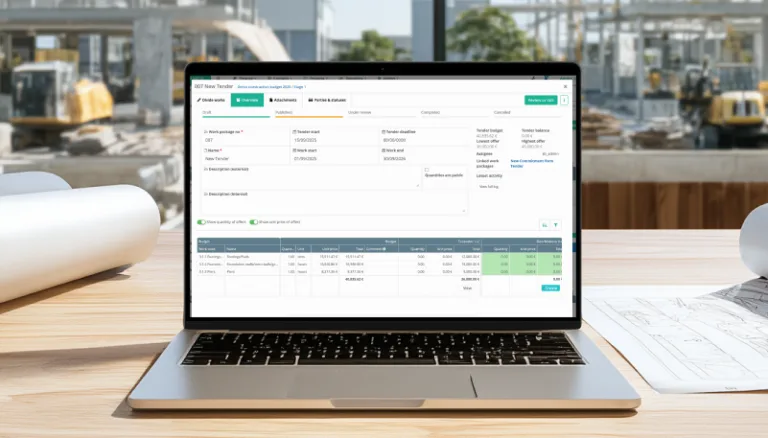
Construction cost management software is a project financial control system designed to manage budgets, commitments, variations, and forecast exposure, providing a real-time commercial position before costs are finalized in the accounting system. It is built around cost codes, work packages, contract packages, and budget structures. In construction environments, cost management systems typically support:
- Budgeting and forecasting
- Purchase orders (PO) and contract management
- Change orders and variations management
- Purchase invoice management
- Cash flow forecasting
- Tender management
- Applications for payment (AFP) management, including certified and uncertified amounts
- Contingency allocation and drawdown
Cost management platforms operate at the commitment and forecast level, providing visibility into:
- Committed vs. remaining budget
- Cost-to-complete calculations
- Approved vs. pending change order exposure
- Forecast revisions at cost-code level
- Alignment of awarded contracts to the original budget
Some construction cost management platforms also allow integration with ERP and accounting systems, but their primary function is commercial control rather than bookkeeping — particularly in multi-package, subcontract-heavy, or developer-led projects. They answer: “Where will this project land financially if current commitments, certifications, and forecast assumptions continue?”
Common construction cost management platforms include Bauwise, Procore, Autodesk, and Buildertrend.
The architectural difference between the two is clear:
- Construction accounting software is structured around financial reporting — ledger-based and transaction-driven.
- Construction cost management software is structured around project cost exposure — budget-based and commitment-driven.
That difference defines their control layer inside a construction business.

2. Construction Accounting vs. Construction Cost Management Software: Side-by-Side Comparison
| Functional Area | Construction Accounting Software | Construction Cost Management Software |
| Primary Purpose | Financial recording, bookkeeping, and statutory financial reporting aligned with tax and audit requirements — reactive. | Project-level budget control and cost exposure management in multi-package, subcontract-driven construction projects — preventive and forward-looking. |
| Core Question Answered | “Are our financial records accurate and compliant — what has been invoiced, paid, recognized, and posted?” | “Where will this project land financially if current commitments and forecasts continue?” |
| Data Source | Posted financial transactions (AP, AR, payroll, GL). | Budgets, commitments, change orders (variations), and forecast cost-to-complete assumptions. |
| Timing of Cost Recognition | Costs reflected after invoices are posted and payroll processed. | At commitments (subcontracts & purchase orders), inlcuding approved but not yet invoiced costs, pending change orders, and forecast exposure tracked before invoicing. |
| Control Orientation | Retrospective financial reporting. | Real-time commercial control. |
| Level of Operation | Company-wide financial structure. | Project, stage, package, or portfolio level. |
| Cost Structure Basis | Chart of accounts aligned to financial reporting standards. | Cost codes, work packages, contract packages, and line-item commitments. |
| Budgeting & Forecasting | • Budget reference for financial planning • Cost-to-date (job cost reporting) • Revenue recognition • WIP-based reporting (cost-to-date vs revenue recognized) • Cost allocation • Cost-to-date vs budget variance reporting • Limited forecasting (based on posted data) | • Detailed cost-code and line item budget breakdowns • Cost-to-complete calculations • Forecast Final Cost (FFC) projections • Commitment vs remaining budget tracking • Change order tracking • Scenario forecasting • Margin analysis • Contingency management |
| Commitment Tracking | No direct visibility of commitments prior to invoice posting. | Full tracking of subcontract commitments, PO, and committed vs uncommitted budget. |
| Procurement (Tender Management) | Typically outside accounting scope. | Supports tender comparison, package tracking, bid analysis, approvals, and budget alignment. |
| Invoice Management | Invoice posting, AP processing, tax reporting. | Validation against commitments, budget checks, subcontract balance control. |
| Change Order Management | Recognized after approval and posting, no visibility into pending variations. | Tracked from proposal stage with real-time impact on forecast, cost-to-complete, and budget. |
| Applications for Payment (AFP / Progress Billing) | Invoice recording and revenue recognition. | Tracks certified work, subcontract exposure, and remaining contract value pre-posting. |
| Cash Flow Forecasting | Company-level cash flow based on posted data, limited forward-looking view. | Project and portfolio-level forecasting based on commitments, schedules, and projected billing. |
| Primary Risk Control & Detection Timing | Financial misstatement — overruns detected after posting. | Budget overruns and margin erosion — detected before posting. |
| User Groups | Finance teams, accountants, CFOs, auditors. | Project and commercial teams (project managers, quantity surveyors, cost controllers), real estate developers, owners, and commercial leadership. |
Read also: 7 Effective Tips on How to Deal With Construction Project Cost Overruns
2.1 Practical Scenario 1: Invoice vs Commitment
Assume a subcontract package budgeted at $1,000,000. During execution:
- $850,000 has been committed under subcontract agreements
- $120,000 in change orders submitted and pending approval
- $600,000 has been certified, invoiced, and posted
- Remaining budget: $150,000 before pending changes
| In Accounting Software: | In Cost Management Software: |
| The project reflects $600,000 in recorded cost. No overrun is visible yet. | The system reflects: • $850,000 committed • $120,000 pending change exposure • Forecast Final Cost (FFC): $970,000–$1,020,000 depending on approvals The exposure is visible before the P&L reflects it. |
Key Difference
That visibility gap — between commitment and invoice — is where margin erosion occurs.
2.2 Practical Scenario 2: Tender Package Price Shift at Award
Assume a tender package is awarded 8% above the original budget due to limited bidder competition.
| In Accounting Software: | In Cost Management Software: |
| No variance is reflected until the subcontract is invoiced and posted. | The awarded subcontract value is immediately recorded as a commitment against the budget, showing reduced contingency and margin compression at award. |
Key Difference
The variance is visible at award — which determines whether early margin compression is managed or missed.
2.3 Practical Scenario 3: Aggregated Financial Reporting vs Forecast Variance
Assume a project forecast indicates subcontract payment acceleration due to schedule compression.
| In Accounting Software: | In Cost Management Software: |
| Subcontract costs are reflected only after invoices are certified and posted, typically at aggregated reporting level (e.g., total subcontract cost: $2.4M). | Package-level forecast position is visible: • Concrete package: 6% forecast over budget • Façade package: 2 pending change orders • MEP package: 3% forecast under budget |
Key Difference
This provides package-level visibility into forecast variance before it erodes margin or impacts the project’s commercial outcome.

3. Operational Threshold: When Cost Management Software Becomes Necessary
Cost management software becomes necessary as project complexity and commercial risk increase, particularly when:
- Projects require detailed cost codes and package-level cost breakdown
- Projects involve multiple subcontractors across several subcontract packages and trade divisions
- Projects have a high volume of change orders that materially impact contingency and forecast
- Forecast Final Cost (FFC) is required instead of cost-to-date reporting, and must be continuously updated based on commitments, change orders, and cost-to-complete
- Procurement involves staged tendering, negotiated packages, or phased awards
- Margin exposure must be actively managed at package level
- Spreadsheet-based cost control becomes unreliable due to volume, change frequency, or multi-package complexity
- Committed costs begin to diverge from budget before invoices are received
- Cash flow timing and subcontract payment obligations must be forecast and managed in line with project schedule
Read also: The Cost Visibility Gap: How Late-Stage Budget Deviations Erode Real Estate Project Profitability
4. Can Both Accounting and Cost Management Software Be Used Together?
For simple projects with limited subcontracting and low commercial complexity, accounting software with basic job costing may be sufficient. As project scale and commercial complexity increase into multi-package, subcontract-heavy, developer-led projects with tight margins — dedicated cost management software becomes more critical.
In practice, most mature construction businesses use both:
• Cost management software for commercial control during project execution.
• Accounting software for statutory reporting, financial consolidation, as well as tax and audit requirements.
Cost data typically flows from project-level cost control into accounting, once approved costs and certified invoices are posted as financial transactions. They serve complementary roles but are not interchangeable. This separation allows finance teams to maintain regulatory accuracy while project teams retain control over cost, commitments, and forecast.
Finally, cost management platforms can integrate with accounting or ERP systems, linking project-level commitments and forecasts directly to financial reporting to enable full-cycle cost control.
Read more: How Synced ERP and Accounting Software Data Can Unlock Real-Time Construction Cost Control
Final Perspective
The distinction between financial reporting and commercial control reflects the difference between recording financial outcomes and actively managing project cost exposure during delivery. In construction, that gap is where margin is either protected or lost.
In environments with tight contingencies, escalating material costs, subcontractor insolvency risk, or phased development structures, the distinction directly determines project margin, profitability, and capital exposure.
About the Author

Taavi Kaiv
Taavi Kaiv is a construction specialist with over ten years of experience in the construction industry. Taavi is an accomplished construction project manager with many successful projects that have been completed under his guidance. Taavi holds a master’s degree in construction management from the Tallinn University of Technology. View profile