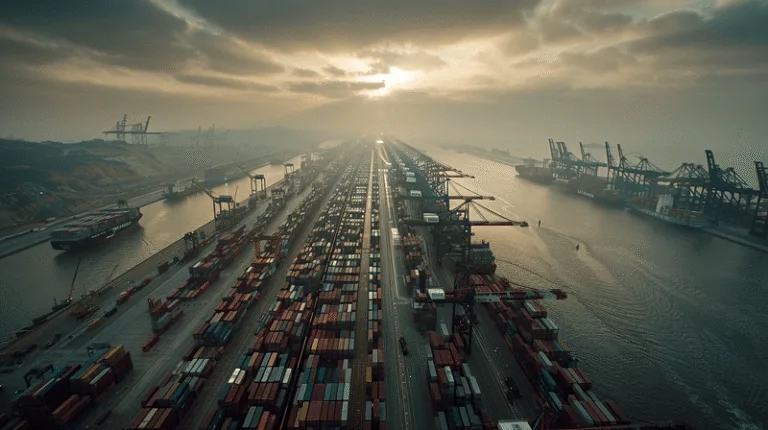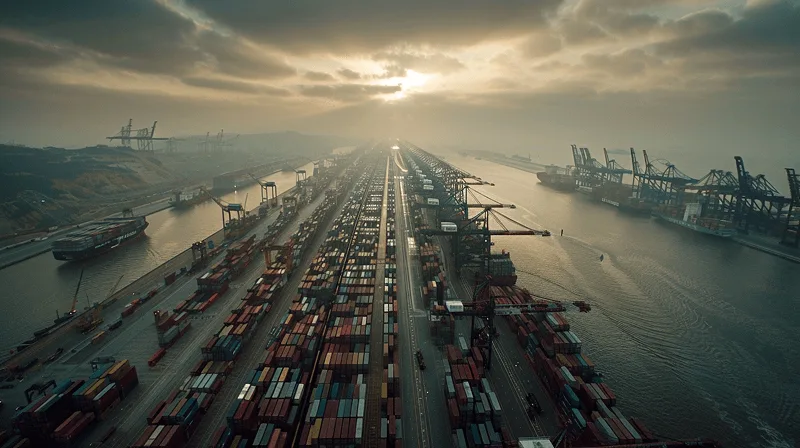
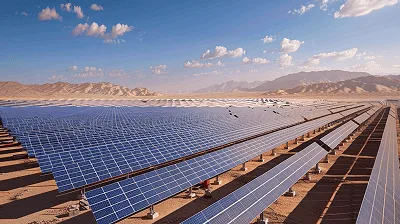
The construction market entering 2026 is increasingly shaped by capital concentration into a narrow set of asset classes — led by major infrastructure projects, as well as energy and digital delivery programmes that underpin critical infrastructure (CI) and national service resilience. Investment is accelerating across water infrastructure, life sciences facilities, transport programmes, defence and industrial capacity, data centres, renewable energy plants, as well as grid reinforcement.
Notable examples of this investment wave include international logistics facilities like DP World’s £1 billion expansion of London Gateway container port and next-generation distribution centres such as Prologis’ development at Daventry International Rail Freight Terminal (DIRFT), alongside proposed ultra-scale renewable energy infrastructure like the $100 billion Western Green Energy Hub (WGEH) and hyperscale data centre investment programmes such as Microsoft’s reported $30 billion AI infrastructure spend.
Despite spanning different sectors and geographies, these projects share a common delivery reality — they are constrained by power availability, specialist capacity, and procurement lead times that force early commercial decisions. Major infrastructure projects are increasingly shaped by global supply chains, where OEM capacity, trade policy, and logistics disruption directly influence programme outcomes. What differentiates them commercially is the timing of irreversible commitments.
As a result, cost and programme outcomes are frequently determined ahead of design maturity and construction mobilisation. Programme-critical packages — including HV/LV switchgear, transformers, standby generators, UPS systems, chillers and heat rejection plant, control systems such as BMS or EPMS, and OEM process equipment — must be committed early to protect critical sequencing and commissioning readiness.
Once these packages are committed, cost exposure is no longer theoretical — it becomes contractual. From contract award onward, the project baseline ceases to be an estimate and becomes a live commitments profile, incorporating deposits, milestone payments, cancellation exposure, interface assumptions, and commissioning dependencies. Market volatility compounds this exposure through supplier repricing, lead-time extension, tariff risk, logistics disruption, and labour availability pressure.
On these projects, the commercial position is often determined by what gets committed first — thus, in such environment, construction cost management becomes a high-consequence discipline. Cost control stops being a retrospective exercise in month-end reporting and valuation and becomes event-driven commercial control focused on lock-in, volatility exposure, and the cost consequences of delivery constraints.
This article outlines major infrastructure project types and explains why long-lead procurement and market volatility require a shift from traditional cost reporting to commitment-led commercial control — now critical to cost certainty, programme reliability, and delivery outcomes.
Read also: Construction Cost Management Trends in 2026: Market Reset and the Commercial Control Loop
Table of Contents
1. Major Infrastructure Project Types
Major infrastructure projects, in some cases referred to as megaprojects, are large-scale, complex programmes that can span several sectors and scopes. From a commercial control perspective, the distinction is behavioural rather than typological. Across sectors, cost and programme exposure is created early through procurement timing, interface definition, and commissioning dependency, often before scope maturity or construction sequencing is resolved. As a result, projects with very different functions and values exhibit the same risk profile once irreversible commitments are placed.
1.1 Core Asset Categories Include
1.1.1 Digital Infrastructure Projects
Digital infrastructure projects are hyperscale data centres and colocation facilities, network hubs, subsea landing stations — where power density, cooling strategy, and OEM equipment sequencing define the critical path.
1.1.2 Energy and Grid Infrastructure Projects
Energy and grid infrastructure projects are substations, transmission upgrades, grid connections, long-lead primary plant (power transformers and GIS), and generation assets — where utility interfaces, regulatory permitting, and technical energisation sequencing govern programme certainty.
1.1.3 Water and Wastewater Infrastructure Projects
Water and wastewater infrastructure projects are treatment works upgrades, pumping stations, reservoirs, and resilience programmes — typically constrained by live-asset tie-ins, regulatory approvals, commissioning windows, outage constraints, and regulatory compliance requirements.
1.1.4 Transport Infrastructure Projects
Transport infrastructure projects are rail stations and depots, signalling upgrades, highway works, and ports — where strict access constraints (possessions and roadspace windows), phased commissioning, and multi-party interface integration drive programme risk and time-related cost.
1.1.5 Defence and Security Facilities Projects
Defence and security facilities projects are munitions and assembly plants, secure logistics sites, airbase upgrades, and command-and-control centres (C2) — characterised by restricted access and security protocols, bespoke systems, operational continuity requirements, and non-negotiable readiness criteria.
1.1.6 Advanced Industrial and Manufacturing Projects
Advanced industrial and manufacturing projects are gigafactories, semiconductor fabs, aerospace and defence manufacturing, and high-spec process plants — where OEM process equipment, rigorous testing regimes, and production ramp-up requirements drive early commitment.
What unifies these project types is how commercial exposure forms. Cost certainty is governed less by trade rates or measured quantities alone and more by commitment timing, interface ownership, and contractually defined energisation and commissioning gates — particularly power availability, systems integration, and commissioning entry and exit criteria. Where these are not explicitly defined and contractually allocated at award, exposure migrates into sequencing and access dependency and becomes difficult to recover through traditional cost mechanisms.
2. What Procurement Looks Like in Major Infrastructure Projects
Procurement in major infrastructure projects is a long-term, strategic process sequenced around constraint release (grid offer acceptance, utility approvals, OEM slot allocation) rather than design completion. Commercial strategy is driven by the need to sequence procurement around power availability, OEM manufacturing slots, and specialist resource constraints to protect programme-critical milestones. As a result, early market engagement is used less to establish competitive pricing and more to secure access to OEM production, specialist labour, delivery windows, and capacity reservation under framework or allocation agreements that cannot be recovered later.
Programme-critical packages are therefore often committed against functional performance requirements and interface assumptions rather than fully developed design, because lead times govern the critical path. This shifts procurement from a single award event into a series of staged commercial decisions — deposits, slot reservations, and conditional awards — each of which progressively reduces optionality. Once production slots are reserved and milestone obligations are triggered, cancellation and rescheduling clauses, payment milestones, and interface obligations become the dominant drivers of cost exposure.
The commercial risk in this environment sits in commitment mechanics rather than headline price. Deposit structures, milestone payment timing, escalation mechanisms, FX exposure for imported OEM plant, scope exclusions, interface responsibilities, and commissioning obligations determine how much downside crystallises if assumptions change. Where these elements are not explicitly aligned at award, exposure does not present as a discrete variation — it manifests later as programme delay, extended preliminaries, rework at interfaces, or commercially unresolvable scope gaps during testing and commissioning. By the time those impacts appear in cost reports, the contractual position is largely fixed, and recovery options are limited to delay, dispute, or inefficient late-stage reallocation.
Read more: Construction Tendering Explained: Procurement, Bids, RFQ, Automation and More
3. Why Market Volatility Is an Issue in Major Infrastructure Projects
Market volatility matters on major infrastructure projects because it compounds the effects of early commitment under constrained capacity. The issue is not simply price inflation, but the instability of commercial terms over time: delivery slots, lead times, payment profiles, warranty positions, tariff pass-through risk, FX exposure, and interface assumptions can shift materially between early engagement and contract award. In a market where OEM and specialist capacity is constrained, those shifts are rarely commercially neutral and often increase downside exposure once commitments are placed.
Volatility also magnifies the cost of timing errors. On conventional projects, procurement can sometimes be deferred to improve price certainty. On major infrastructure projects, deferral frequently displaces programme-critical sequencing and commissioning readiness stages, triggering programme prolongation, extended temporary systems, or loss of critical access windows. Procurement therefore becomes a timing trade-off: commit early and accept lock-in risk, or delay and absorb programme disruption and repricing exposure.
In this environment, volatility must be managed as a forecast risk tied to commitment timing, not as a post-contract price adjustment. Treating volatility as a generic inflation allowance typically results in silent contingency erosion, as exposure materialises through programme movement, term changes, interface knock-on effects, and time-related cost growth rather than through headline rate increases.
Read also: Cost Uncertainty in Construction: The Impact on Quantity Surveying and Financial Control
4. Why Traditional Cost Control Can Fail on Major Infrastructure Projects
Traditional cost control fails on major infrastructure projects because it is designed to track spend, not to manage exposure. Standard commercial models assume a linear sequence: scope matures, rates are agreed, costs are incurred, and variance is then reported. On major infrastructure projects, exposure is created well before that sequence completes.
Cost risk is established at the point of commitment, not at the point of valuation. Early procurement decisions made to secure power availability, specialist capacity, and OEM manufacturing slots lock in deposits, milestone obligations, cancellation risk, interface assumptions, and commissioning dependencies while scope and design are still evolving. As a result, exposure accumulates through contractual position and programme dependency rather than through measured quantities or instructed change.
This creates a systemic gap in conventional reporting. Projects can appear commercially stable while material risk is building outside package budgets and valuation cycles. Extended preliminary costs driven by delayed energisation, attendance obligations and access constraints, prolonged temporary systems, and rework caused by late interface definition all develop as time-related and system-driven costs. These effects do not register as discrete variances until delays, access constraints, or rework have already been absorbed into the live programme and supply-chain plan.
Compounding the reporting lag, scope and obligation change on major infrastructure projects rarely arrives through a single instruction. Scope evolves through design development, operational requirements, utility constraints, and OEM coordination, meaning exposure often emerges as incremental scope accretion rather than formal variation. Where cost control relies on instruction-based change capture alone, projects accumulate latent risk: unpriced commitments, interface assumptions that harden into deliverables, and commissioning requirements that expand late in delivery, when flexibility is lowest and recovery cost is highest.
At that point, remaining available recovery actions are no longer commercial controls but programme responses — delay, dispute, or inefficient late-stage mitigation. In this environment, cost control based on retrospective valuation and month-end reporting is not just slow — it is structurally misaligned with how risk is created.

5. Effective Construction Cost Management for Major Infrastructure Projects
Effective construction cost management on major infrastructure projects is structured around governing exposure before commitments are placed, ensuring scope boundaries, interface ownership, and energisation and commissioning criteria are contractually enforceable.
The commercial forecast must operate as an integrated commitment and dependency model — linking contractual obligations and conditional liabilities created through procurement to programme sequencing and the triggering events that convert those obligations into cost. This requires visibility of:
- committed contractual liabilities (deposits, milestone payments, cancellation and rescheduling exposure)
- conditional exposure tied to sequencing, access, and contractual assumptions
- dependencies on energisation, utility readiness, systems integration, as well as testing and commissioning entry/exit criteria
- programme movements that drive time-related cost (preliminary costs, temporary systems, access constraints)
Cost control in major infrastructure projects is exercised at decision points. Procurement approvals, resequencing, loss or delay of energisation, utility interface changes, commissioning slippage, and interface realignment must immediately update the cost-to-complete forecast. Waiting for these effects to surface through valuation cycles is insufficient. Clear ownership of scope boundaries, attendance obligations, access regimes, temporary systems responsibility, and testing and commissioning entry/exit criteria is therefore critical — and must be defined contractually.
Interface risk must not be allowed to drift into programme dependency — once it does, time-related cost accumulates and cannot be recovered through rates or late change. Contingency is allocated against identified exposure. It is released only through explicit commercial trade-offs between commitment, programme risk, and cost consequence, rather than allowed to be consumed implicitly through delay, drift, or unvalued time.
Where implemented, this approach keeps the forecast predictive and allows intervention while outcomes are still influenceable. Without it, commercial control becomes descriptive, and commercial outcomes are dictated by commitments already placed.
Read also: The Cost Visibility Gap: How Late-Stage Budget Deviations Erode Real Estate Project Profitability
Conclusion
Major infrastructure projects in 2026 are being delivered in a market where outcomes are constrained as much by power availability, specialist capacity, and procurement lead times as by construction capability. The differentiator is whether the project operates a forecast model that captures contractual exposure, sequencing risk, and commissioning readiness in real time — before those risks convert into time-related cost.
In practice, the strongest commercial outcomes come from treating procurement and programme events as cost triggers, enforcing interface ownership as a contractual position, and governing contingency as a managed trade-off rather than a residual buffer. Teams that adopt this control discipline retain the ability to influence cost and programme before lock-in converts exposure into irreversible outcome.
FAQ
What are mission-critical projects?
Mission-critical projects often sit within major infrastructure programmes where continuous availability, resilience, and operational uptime are non-negotiable. Typical examples include healthcare, utilities and transportation infrastructure, defence systems, life sciences and other regulated manufacturing facilities, data centres, and operational control centres supporting essential services. In these environments, failure or delay has immediate operational, financial, or societal consequences.
From a cost management perspective, mission-critical projects intensify existing infrastructure risks. Redundancy requirements, integrated systems testing, commissioning complexity, and strict handover criteria expand interface scope and extend programme and commercial exposure. These characteristics amplify the impact of procurement timing, late change, and commissioning delays, making early commercial control essential.
What’s the difference between Critical Infrastructure (CI) and Critical National Infrastructure (CNI)?
Critical infrastructure (CI) refers broadly to assets and systems essential to the functioning of economies and societies, including energy, water, transport, communications, healthcare, and digital infrastructure. The term is used internationally to describe infrastructure whose disruption would have significant economic or societal impact.
Critical National Infrastructure (CNI) is a UK-specific designation applied to assets considered vital to national security, economic stability, and public safety under UK national security and resilience frameworks. While the designation differs by jurisdiction, the delivery challenges are similar: heightened reliability requirements, regulatory oversight, and constrained tolerance for delay or failure. In practice, many major infrastructure projects — particularly in energy, transport, water, and digital sectors — fall within CI globally and are often classified as CNI in the UK.
How major infrastructure projects differ from megaprojects?
Megaprojects are primarily a scale classification and are commonly defined in industry and academic literature as programmes exceeding approximately US$1bn in capital value, spanning multiple years, and carrying national or strategic delivery consequences. Major infrastructure projects include megaprojects, but they also include a broader set of high-spec, high-consequence assets that may sit below that value threshold while still behaving commercially like megaprojects because of constraint intensity and delivery complexity.
The more useful distinction in 2026 is not “big versus bigger,” but how early the project’s commercial position becomes locked in. A £300m project with power dependency, long-lead equipment, complex commissioning, and interface-heavy scope can create more commercial risk than a £1.2bn programme with stable scope and clean contracting boundaries. Megaprojects amplify risk through scale; major infrastructure projects concentrate exposure through early commitment, interface density, and operational readiness requirements.
About the Author

Mikk Ilumaa
Mikk Ilumaa is the CEO of Bauwise, a leader in construction financial management software with over ten years of experience in the construction software industry. At the helm of Bauwise, Mikk leverages his extensive background in developing construction management solutions to drive innovation and efficiency. His commitment to enhancing the construction process through technology makes him a pivotal figure in the industry, guiding Bauwise toward setting new standards in construction financial management. View profile