Sage is finance, HR and payroll software for small and medium businesses, offering products like Sage Accounting, Sage Sole Trader, Sage Intacct, Sage HR and Sage X3. Bauwise is a construction cost management software for subcontractor-driven constructed projects, offering live commercial control — budgets against actuals, subcontractor commitments, tender packages, change orders (variations), payment applications and cash flow forecasting. While both are used for construction financial control, they cover different project workflows: Sage is the financial system of record — the ledger, the returns, the statutory reporting, Bauwise is the commercial control layer the project team works in to effectively run concurrent projects.
The page contains helpful information for main contractors, real estate developers and owners weighing Sage vs Bauwise and provides recommendation on when to use which tool.
Read also: Procore vs Bauwise: Construction Cost Management Compared
Table of Contents
What Each Tool Actually Does
| Sage | Bauwise | |
| Category & Core Job | Finance, payroll and HR software — accounting, compliance and statutory reporting | Construction-native cost management and commercial control software — procurement, commitments, cost forecasting |
| Built For | Small and medium businesses across every sector — bought and operated by finance, payroll and HR teams | Main contractors, real estate developers and owners running subcontract-driven projects — operated by commercial and project teams |
| Construction Project Costing Depth | Ranges by product — from entry-level in Sage Accounting, to real-time job costing, committed costs and WIP reporting in Sage Intacct Construction | Full budget-vs-actual cost control, purchase orders, subcontracts, retentions, contingency, risk management and live forecasting |
Sage and Bauwise are different categories of software serving different functions in the same business. Sage runs the finances and HR — the ledger, VAT and CIS, payroll, consolidation across entities, and at the Intacct Construction end, job costing and WIP reporting against every contract. Bauwise holds the cost position of each live project: budget, revised budget, committed cost, forecast and actuals at cost code level, maintained by the commercial team as packages are tendered, subcontracts awarded, variations valued and claims assessed. Because each system does a different job, one does not substitute for the other — used together, they reinforce cost control.
Read also: Xero vs Bauwise: Do You Need Both for Construction Cost Control?
Sage vs Bauwise for Construction Commercial Control: Feature-by-Feature Comparison
| Feature | Sage | Bauwise |
| General ledger, bank reconciliation, statutory financials | ✓ Full accounting system of record, MTD-compatible across the range | ✗ Not supported |
| VAT, CIS and domestic reverse charge | ✓ CIS and domestic VAT reverse charge built into Sage Accounting | ✗ Not supported — statutory compliance stays in accounting |
| Payroll | ✓ Supported | ✗ Not supported |
| Job costing (budget vs. actual) | ✓ Sage Intacct Construction tracks actual and committed costs across labour, materials, plant, subcontractors, overhead and change orders. Sage 50 Professional has a Projects module with cost codes, cost types and budget against actual. | ✓ Budget, revised budget, commitment and cost forecast per cost code, rolling up to project and portfolio level |
| Tender management and subcontract procurement | ✗ Not part of Sage’s construction accounting products. Sage Construction Management covers leads, estimates and project setup from contract to completion | ✓ Tender packages created from budget lines, ITT issue, login-free bidder submission, automatic bid comparison, award converts the same line into a contract or PO |
| Commitments (purchase orders and subcontracts) | ✓ Committed cost tracking in Sage Intacct Construction, purchase orders available in Sage 50 Professional | ✓ Contracts and POs raised directly from budget lines, tracking actuals, advances and accruals as work proceeds |
| Change order / variation management | ✓ Supported in Sage Intacct Construction | ✓ Approved variations linked to their related contracts and cost codes, with budget, commitment and EAC impact calculated automatically |
| Applications for payment (subcontractor claims) | ✗ Billing in the construction accounting products is client-side — automated and retention billing out, rather than assessment of inbound subcontractor claims | ✓ Structured Applications for Payment workflow with retentions and back charges applied automatically |
| Retention | ✓ Retention billing and retention balances held in the ledger | ✓ Retention applied and tracked at contract and payment application level |
| Cost-to-complete and forecast at completion | ✓ PM forecast cost captured in the WIP schedule in Sage Intacct Construction | ✓ Forecast to Complete and Estimate at Completion generated automatically, cascading from commitments and variations |
| Revenue recognition and WIP | ✓ Automated WIP by job and sub-job with over- and under-billing, plus revenue recognition posted to the ledger, in Sage Intacct Construction | ✓ Calculates the WIP cost and revenue position against budget, commitment and forecast, aligned to Cost-at-Completion |
| Cash flow forecasting | ✓ Business-level cash flow forecasting in Sage Accounting from the Standard tier and in Sage 50 | ✓ Project-level cash flow baselines generated with one click, refined and tracked through version control |
| Multi-entity consolidation | ✓ Consolidated multi-entity financials in Sage Intacct, with every transaction dimension-tagged for reporting across entities | ✗ Not a consolidation ledger — Bauwise provides a portfolio view comparing budgets, costs and forecasts across projects |
| Subcontractor portal | ✗ Not part of Sage’s construction accounting products | ✓ Free subcontractor portal for payment applications and tender responses, included with the Professional plan |
| Mobile approvals | ✓ Mobile app for Sage Accounting — invoicing and receipt capture | ✓ Invoice review and approval on mobile, with AI data extraction from photographed documents |
When to Choose Sage, Bauwise, or Both?
- Choose Sage If — you need bookkeeping, VAT and MTD, CIS and payroll, and finance-side cost reporting rather than a commercial workflow. Sage Accounting handles CIS deductions and VAT domestic reverse charge natively, with project, department and cost centre tracking through analysis types. Sage 50 Accounts Professional adds a Projects module with cost codes, cost types and budget against actual per project. Sage Intacct Construction goes further again — committed and actual costs at cost code level, change order tracking, automated WIP, retention billing and multi-entity consolidation.
- Choose Bauwise If — you’re running multiple live construction or development projects with subcontractors doing most of the work, your commercial team and outside parties — quantity surveyors, project managers, consultants — still run budgets, variations and valuations in separate spreadsheets, and you need the tender-to-final-account cycle in one system: tender packages, subcontract awards, variation valuation, subcontractor payment applications and retention, with unlimited projects on every plan.
- Use Sage and Bauwise Together If — you want full commercial control on every live project sitting on top of the accounting you already run: budgets, commitments, tenders, variations, payment applications, retention and forecast in one system, with the ledger, VAT, CIS, payroll and statutory reporting staying in Sage — so finance reports on cost already allocated to the right project and cost code, and the commercial team sees budget, commitment, forecast and actual as spending happens.
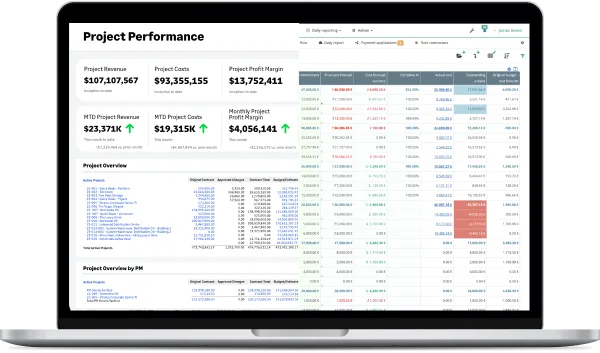
How Sage to Bauwise Integration Works
Bauwise can be connected to Sage alongside other accounting and ERP systems — Xero, QuickBooks, Microsoft Dynamics 365 Business Central, SAP, Odoo and others — so replacing your accounting platform is not required to have:
- Bi-directional data flow: budgets and invoices can be imported from Sage, with actuals, transactions and supplier details syncing in both directions.
- Invoices arrive pre-filled: purchase invoices can be imported with cost codes, project tags and contract details already populated, then routed for internal approval with status tracking. Emailed and uploaded invoices are read by built-in AI extraction, which pulls invoice number, supplier, amount, date and payment terms.
- Data returns enriched: approved costs go back to Sage carrying cost allocation and budget line details, with related purchase orders, contracts and Applications for Payment attached — supporting accurate GL coding.
- Balances stay current: advance payments and retention balances can update from Sage, and supplier records are validated by registration number on every inbound invoice without creating duplicate entries.
With the integration set up, Sage keeps the ledger, VAT, CIS and statutory reporting, while the commercial team works from a live picture of budget, commitment, forecast and actual in one place.
Read also: Excel vs Bauwise: When Construction Cost Control Outgrows Spreadsheets
Pricing Sage vs Bauwise
Sage (UK Plans)
| Product / Plan | Price (after intro offer) | Includes |
| Sage Accounting Start | £20/month + VAT | 1 user. Unlimited sales invoices, bank reconciliation, VAT and MTD, payroll, carbon footprint tracking, Sage Copilot |
| Sage Accounting Standard | £43/month + VAT | 3 users. Everything in Start, plus CIS management and submission, quotes and estimates, cash flow forecast, custom reports |
| Sage Accounting Plus | £59/month + VAT | Unlimited users. Everything in Standard, plus budgets, multi-currency invoicing, exchange rates, stock and inventory management, receipts and invoice scanning |
| Sage 50 Accounts Standard | From £115/month + VAT | Desktop accounting with cloud access, MTD, automated bank reconciliation, invoices and quotes, stock, multiple companies, departments and budgets. CIS submission and additional users carry extra fees |
| Sage 50 Accounts Professional | From £234/month + VAT | Everything in Standard, plus sales and purchase orders, Projects module (project costing), fixed assets register, advanced stock and multi-currency |
| Sage Intacct Construction | Quote-based | Real-time job costing, revenue recognition and retention billing, automated WIP by job and sub-job, real-time dashboards with dimension-driven reporting, multi-entity consolidation, CIS compliance, open API |
Sage list prices exclude VAT and are quoted before promotional discounting. Sage Intacct Construction is not publicly priced — cost depends on modules, entities and users.
Bauwise
| Plan | From | Includes |
| Essential | €297/month + €19/user | Budget management, purchase orders & contracts, purchase invoice management, basic change orders, API |
| Advanced | €597/month + €19/user | Everything in Essential, plus advanced change orders, tender management, portfolio overview |
| Professional | €897/month + €19/user | Everything in Advanced, plus payment applications, subcontractor portal access, cash flow forecasting, reporting |
| Enterprise | Custom | Custom integrations for large organisations |
Sage and Bauwise are bought to solve different construction cost management problems. The decision isn’t which one wins on features, it’s which cost control workflows your team needs.
Frequently Asked Questions
Is Bauwise a Sage Alternative?
Bauwise is a commercial control layer, not an accounting system — it’s designed to work alongside Sage rather than replace it. Bauwise runs the project side: budgets, commitments, tenders, variations, payment applications, retention and forecasting. The general ledger, payroll and statutory reporting stay in Sage.
Does Bauwise Integrate with Sage?
Yes. Bauwise can be integrated with Sage to bring invoices in for coding and approval, post approved and allocated costs back, and keep transactions, actuals and supplier records aligned across both systems without manual re-entry.
Which Sage Product Is Best for Construction Cost Control?
For finance-side cost reporting, it depends on size: Sage positions Sage Accounting for construction businesses of roughly 1–19 employees and Sage Intacct Construction for 20 and above, with Sage 50 Accounts Professional in between adding a Projects module and purchase orders for contractors needing job-level costing without a full financial management platform. Sage’s construction accounting products cover job costing, WIP and billing — if your projects are subcontract-driven and require running tendering packages, awarding subcontracts, valuing variations, assessing subcontractor applications and applying retention, Bauwise is a better choice for centralised construction cost management.
Does Sage Intacct Construction Remove the Need for a Cost Management Layer?
Sage Intacct Construction covers job costing, committed costs, WIP by job and sub-job and retention billing from the finance side. What it doesn’t run is the commercial cycle those figures come from: how subcontract packages are tendered and awarded, how variations are valued and approved, how subcontractor applications are assessed, and how forecasts are revised in between. Where that cycle still runs in spreadsheets, a centralised commercial control layer earns its place regardless of what the accounting platform can report.
Can I Use Bauwise if I Don’t Use Sage?
Yes. Bauwise works as a standalone commercial control layer, including purchase invoice management, and integrates with a range of accounting and ERP systems. It suits main contractors, developers and owners running subcontract-driven portfolios, CAPEX-heavy developments across multiple legal entities, and teams managing live project costs in more than one country.
Does Bauwise Handle VAT, CIS or Payroll?
Bauwise covers the project side — budgets, commitments, variations, payment applications and forecasting. VAT, CIS and payroll stay in Sage or your existing accounting platform.
Is Sage or Bauwise Cheaper?
Sage Accounting runs £20–£59 per month plus VAT, Sage 50 Accounts from £115, and Sage Intacct Construction is quoted per organisation. Bauwise starts at €297 per month plus €19 per user, with unlimited projects at every tier — so portfolio growth doesn’t change the price. The two aren’t priced for the same job: Sage covers company accounting, Bauwise covers commercial control across the portfolio, and the two scale differently — Sage by users and entities, Bauwise by commercial users regardless of how many projects run.
Page last reviewed: August 2026.