Many resources share advice on how to avoid project cost overruns in construction. But in reality, most contractors only start looking for solutions once the financial damage has already been done. So what do you do when your construction project is exceeding its budget — especially if you run a subcontract-heavy business managing multiple subcontractors and complex financial commitments?
In this article, I’m sharing practical actions that have helped me in real projects and can help your construction company regain commercial control before margins slip further.
When I started my first company, I quickly ran into serious budget problems. Trying to win new clients, I worked on thin margins, agreed to additional scope too easily, and underestimated the commercial risk behind subcontractor commitments. That is one of the fastest ways to lose control of a project’s profitability.
Because I’ve been through this personally — and discussed it with many construction professionals — I’ve outlined 7 actions that actually help when cost control begins to break down.
If you are currently dealing with a project that is going over budget, start with these steps:
- Understand the real reasons behind your construction project’s budget overrun
- Create an action plan to recover from the cost overrun
- Be responsive to your customers and subcontractors
- Talk to your team honestly and agree on the construction priorities
- Try to retrieve the construction budget, but don’t be greedy
- Stop construction work when payments are late
- Implement a real-time construction cost control system
Table of Contents
1. How Common Are Cost Overruns in Construction Projects
Before outlining the 7 effective actions, it’s worth understanding how widespread cost overruns are in construction. They are not isolated incidents — they are a recurring industry pattern. Studies suggest that 75%-90% of construction projects exceed their initial budgets, and that average cost overruns often go over 20%.
Budget overruns are particularly common in subcontract-heavy projects, where commercial responsibility is split across multiple subcontract agreements, change orders, and payment structures. When financial control is fragmented, budget pressure gradually builds across commitments and variations until the financial impact becomes visible — often after margins have already eroded.
2. Effective Tips on How to Deal with Construction Cost Overruns
2.1 Understand the Real Reasons of Construction Budget Overrun
Usually, you can’t solve a problem without understanding what’s causing it. Project costs can exceed the planned budget for many reasons — from inaccurate estimates and frequent design changes to owner-related constraints. The key is to identify the specific causes in your project. In construction, budget issues are often the result of several factors combined. The sections below provide a clearer picture of what may be driving the problem.
2.1.1 Underestimated or Wrong Construction Budget Calculation
One of the main reasons for construction cost overruns is inaccurate budget estimation. If the original contract scope remains unchanged, it becomes very difficult to recover from an underestimated budget and regain the lost margin. The key lesson is to identify where the estimate was wrong — whether due to pricing errors, missing scope, or unrealistic assumptions. In some cases, projects are intentionally underpriced to win the contract, with the expectation that the margin will be recovered later. Whatever the reason, the root cause must be clearly identified to avoid repeating the same mistake.
In many cases, estimation errors originate during tendering, when competitive pressure pushes contractors to rely on aggressive assumptions, incomplete drawings, or optimistic productivity rates. In subcontract-driven projects, risks are frequently underestimated in areas such as provisional sums, unit-rate variability, interface coordination, and indirect costs. If these exposures are not clearly quantified and contractually protected before signing, the margin erosion is built into the project from day one.
2.1.2 Construction Project Scope Creep
Some construction clients continuously ask for small changes, explaining how easy it would be for you as a contractor to implement them, while not expecting to be billed for the additional work. Sometimes they even promise larger amounts of future work in exchange for the additional work being done without formal variation. In reality, these “small requests” eventually go out of control. Going the extra mile quickly becomes an expectation rather than an exception. It’s like “feeding the monster”.
Instead, you should clearly define the agreed scope, complete what has been contractually committed, and ensure that all additional work outside the scope is formally approved and paid for. Avoid describing your work as easy, fast, or simple — these words reduce the perceived value of the work and weaken your commercial position.
In subcontract-driven projects, scope creep rarely appears as one large variation. It typically accumulates through undocumented instructions, informal site agreements, and partially approved changes that are executed before commercial terms are finalized. When change management processes are weak, the contractor effectively finances the project by carrying unapproved variations, which increases exposure and destabilizes cash flow.
2.1.3 Long-Term Economic Effect
Long project durations can significantly increase the risk of budget overruns, especially if the project is paused or if the original pricing was calculated during a low-cost economic period and market conditions later changed. Rising material prices, labor cost inflation, and supply chain disruptions can quickly erode planned margins.
In subcontract-driven projects, this risk is amplified because subcontractor agreements, material contracts, and unit rates are often fixed early, while actual execution may occur months or years later. If escalation clauses, price adjustment mechanisms, or index-linked provisions are not included in the contract, the contractor absorbs the cost increase.
It is important to review the contract terms carefully and understand whether the contract includes escalation clauses or permits formal price adjustments under changing economic conditions.
2.1.4 Weak Construction Cost Management and Control
The worst thing is finding out only at the end of the project that you are over the construction budget. Usually, this is closely related to poor budget management. It is also very common to pay less attention to budget and cost control when times are good. Everybody feels confident because the overall financial picture looks strong, and early warning signals can slip unnoticed.
Without consistent cost tracking, subcontractor invoices may exceed agreed amounts, scope changes may not be properly converted into approved change orders, and large unpaid invoices may be left sitting in a drawer. Over time, these discrepancies accumulate and erode project profitability before you even realise it.
To avoid this, ensure you have reliable real-time data that accurately reflects your budget position. If not, take action to obtain it immediately. Contractors must maintain visibility over budget vs. actual costs, subcontractor commitments, approved variations, and cash flow exposure throughout the project lifecycle.
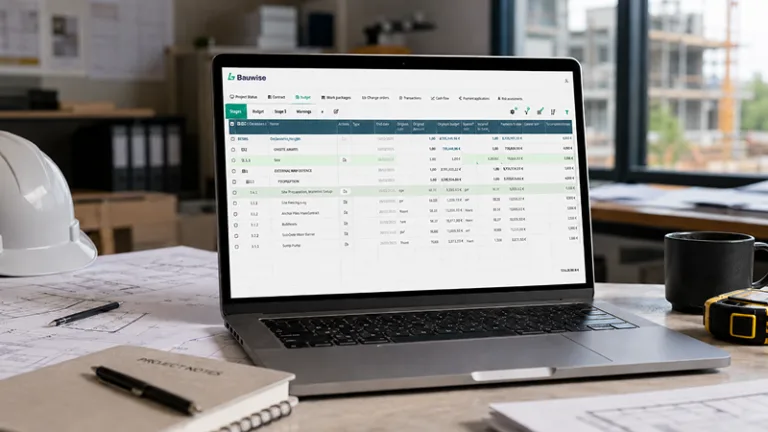
This level of commercial control is typically supported by structured construction cost management platforms like Bauwise. Built for subcontract-driven construction projects, it provides real-time financial visibility, helping manage high contract volumes, frequent variations, and the financial risk associated with multiple subcontract packages.
2.1.5 Poor Construction Resource Utilization
Poor management or inefficient use of construction resources eats into your project margin and leads to budget overruns. This does not necessarily mean that your employees or subcontractors are performing poorly. More often, it means teams are constantly switching between projects or construction sites without fully completing tasks, which reduces productivity and increases costs.
This situation is common when business is booming and subcontractor availability is limited, forcing companies to allocate the same crews across multiple projects simultaneously. Frequent crew switching also increases remobilization time, coordination inefficiencies, and indirect costs, further reducing project profitability.
2.1.6 Construction Time Overrun
Construction time overruns are directly connected to budget overruns. Extended project duration increases site overhead, equipment rental, required supervision, and indirect expenses. The longer the project runs, the greater the cost exposure.
Delays also affect subcontractor sequencing, create inefficiencies, and may trigger contractual penalties or liquidated damages. For this reason, it is critical to forecast potential delays early and take corrective action before additional time-related costs accumulate.
There are, of course, other reasons why construction projects go over budget, but these examples should help you identify the root causes in your own project.
Read also: CIS Regulation for UK Main Contractors: 2026 Changes and Construction Industry Scheme Explained

2.2 Create an Action Plan to Tackle Construction Budget Overrun
Once you understand what is causing your construction budget overrun, you can create an action plan to bring the project back on track. Too often, management reacts by trying to extinguish immediate problems instead of addressing the underlying financial exposure.
At this point, the most important thing is to take the time to focus, create a clear plan, and start implementing it immediately. Without a structured plan, decisions become reactive and inconsistent, which can increase the financial damage.
At a minimum, the action plan should include a revised cost forecast, a cash flow assessment, a review of subcontractor commitments, and a clear prioritization of cost-critical activities. Without updating the financial baseline, it is impossible to understand how far the project has drifted and what recovery options are realistically available.
As Seneca said, “If one does not know to which port one is sailing, no wind is favorable.” You and your team must clearly understand what needs to be done to improve the situation. Sometimes planning will show that there is no better way out of the situation. Even if it cannot fully reverse the outcome, it can help you limit additional losses and avoid further trouble.

2.3 Be Responsive to Your Customers and Subcontractors
When things are going south, avoiding communication with your clients or subcontractors is not the best decision. You may not know what to say, or you may be afraid of their reaction. Still, be responsive and show a clear willingness to communicate. This builds trust and credibility. Do not try to hide problems or even worse — do not lie.
Instead, you can openly say: “I know the situation looks [is] bad, and here is the reason […]. I am working on a plan right now and will get back to you by [specific date].” Then keep your promise, regardless of the circumstances. If people cannot reach you or you fail to follow through with the given promises, clients and subcontractors become nervous — and the situation can escalate quickly.
In subcontract-heavy projects, delayed communication can quickly create contractual and cash flow risk. Subcontractors may slow down work, submit protective claims, or prioritize other projects if they sense financial instability. Clients, on the other hand, may escalate oversight or withhold payments if transparency disappears. Clear and proactive communication reduces uncertainty and protects working relationships during financially sensitive periods.
2.4 Talk to Your Team Honestly and Agree on the Construction Priorities
Sometimes construction business owners try to protect their team from bad news. Maybe it is because we want the team to stay motivated, or maybe we want to protect our own image in their eyes. Regardless of the reason, I believe this approach is wrong.
If you have a good team, they can come up with valuable ideas and may even help you save the business. When they understand the real situation, they can focus on the right construction priorities and act more effectively on the most important tasks.
In projects that are under financial pressure, clarity inside the team is just as important as clarity with clients and subcontractors. When site managers, project engineers, and commercial teams understand the margin constraints, they make different decisions — they control overtime, question unnecessary costs, push for timely approvals, and prioritize activities that protect cash flow. Without that shared understanding, resources are often spent on tasks that do not improve the project’s financial position.
2.5 Try to Regain Construction Budget, but Don’t Be too Greedy
When construction costs are running over budget, the first thing you should do is stop scope creep. Instead, carefully manage and track change orders. Be sure that nothing is done without proper approval.
One way to regain part of the lost budget is to negotiate better pricing or terms for materials and works, or to renegotiate contracts with subcontractors. But don’t be too greedy — this might damage relationships with the other parties. Keeping fair pricing and good relationships with clients and subcontractors is a long-term strategy for success.
It is important to distinguish between disciplined commercial recovery and short-term cost cutting. Focus on recovering value through proper variation claims, tightening procurement terms, improving cost tracking, and eliminating inefficiencies — not by reducing quality or shifting unfair risk to subcontractors. Sustainable recovery protects margin without creating new operational or contractual problems.
2.6 Stop Construction Work When Payments are Late
I have seen situations where the owner does not pay invoices on time, and the general contractor continues construction patiently. Then suddenly the client goes bankrupt, and the legal process begins — creating even more financial damage.
If a client does not pay on time, immediately contact them and clarify the reason for the delay. It may be a temporary liquidity issue or a delay in payments from their own client.
The rational decision in such situations is to suspend construction work until payment is received. This also gives the client an opportunity to find alternative financing or assign the project to another party if necessary. Do not continue investing significant resources into a financially unstable project.
Before suspending work, review your contract carefully and follow the formal notice requirements. Most construction contracts include clauses that allow suspension in case of non-payment, but they require written notice and defined waiting periods. Acting within contractual terms protects your legal position and prevents the situation from escalating into a dispute.
2.7 Set Up Cost Management With the Construction Cost Control System
If a construction project is experiencing a budget overrun, it is critical to implement a structured cost management system such as Bauwise. This provides clear visibility over budget vs. actual costs, subcontractor agreements, change orders, cash flow, and online purchase invoice approvals.
Project managers and company leadership must operate with real-time data and monitor key financial indicators such as project margin, completion percentage, cost forecasts, and committed costs. Outdated or fragmented information delays decision-making and hides financial exposure.
A structured construction cost management system saves time, improves cost tracking, and strengthens commercial control across the project lifecycle.
More importantly, real-time financial visibility allows management to detect deviations early — before they turn into major losses. When commitments, variations, and actual costs are continuously updated, emerging risks become visible while there is still time to intervene. In subcontract-heavy projects, where financial exposure is distributed across multiple packages, this level of control is essential to protect project margin.
Conclusion & Bonus Tip – How to Deal with Construction Project Cost Overruns
In real life, even with proper planning and disciplined execution, project cost overruns can still happen. The key is not only to learn from mistakes, but also to understand what worked well and reinforce those practices across future projects.
Continuous improvement in estimation, commercial control, subcontractor management, and cost forecasting reduces long-term risk. The steps described above have helped me significantly, and I believe they can help you build a more resilient and commercially disciplined construction business.
Over time, the most successful construction companies build a culture of commercial awareness — where project managers, site teams, and commercial staff understand how daily decisions impact margin and cash flow. Cost control is not treated as a one-time recovery action, but as an ongoing discipline embedded into every stage of the project.
In the end, smart construction companies under promise and over deliver.
Related posts
Read our other articles where you can find useful and relevant information about construction cost management:
- Ultimate guide to construction cost management
- Construction cost management: All you need to know
- 10 Tips to Reduce Construction Costs and Save a Fortune
- 7 Essential Tips for Creating and Using Construction Cost Codes
- Cost codes in the construction Industry: What are they and why are they important?
- 6 tips to have better control of your construction projects financials
- 9 tips to manage construction budget and control costs with a smile
About the Author

Mikk Ilumaa
Mikk Ilumaa is the CEO of Bauwise, a leader in construction financial management software with over ten years of experience in the construction software industry. At the helm of Bauwise, Mikk leverages his extensive background in developing construction management solutions to drive innovation and efficiency. His commitment to enhancing the construction process through technology makes him a pivotal figure in the industry, guiding Bauwise toward setting new standards in construction financial management. View profile